


Listen on Apple Podcast | Listen on Spotify
For most business owners, March feels like the tail end of Q1 — a season of momentum, pivots, and quarterly recalibration. But for school leaders, March is something else entirely. It’s the midpoint. You started in August or September, and now, six or seven months in, your school has done something that no audit, survey, or performance review could ever replicate.
It has told you the truth.
By March, the school year has already told the truth. The question is whether you’re willing to listen.
This episode of the Schools of Excellence podcast is an invitation to stop, tune in, and truly hear what this season is showing you — because what you do with these signals in March will determine whether you finish the year strong or barely survive until June.
Why March Is the Most Revealing Season in the School Year
March holds a unique kind of pressure. You’ve moved through the fresh energy of the fall, the disruptions of holiday season, the grind of flu season, and the emotional labor of winter. And now here you are — tired, a little thinner on the margins (financially and personally), and standing at a crossroads.
Here’s what March is showing you right now, whether you’ve named it yet or not:
- You already know who is not aligned on your team.
- You already know which classrooms feel unstable.
- You know exactly why enrollment numbers look the way they do.
- You know where communication is breaking down and why.
- And you know where you’ve been over-functioning — absorbing what should belong to someone else.
You know all of this because your regular rhythms — your one-on-ones, walkthroughs, check-ins — have been feeding you data all year long. The question isn’t whether the signals exist. The question is whether you’re treating them as information or ignoring them as inconvenience.
Circumstantial vs. Infrastructure: The Distinction That Changes Everything
Here’s the most important reframe you’ll hear today: not all problems are created equal.
There’s a massive difference between a circumstantial problem — something that happened once due to a specific event — and an infrastructure problem, which is a pattern that keeps repeating because your school doesn’t have the structure to hold it.
If something has been repeating since August, it’s not circumstantial anymore. Now it’s infrastructure.
Think about it. If you’ve had the same conversation with a staff member about punctuality two, three, four times since August, that’s not bad luck. That’s a missing standard. If your classrooms aren’t staying clean despite having checklists, binders, and reminder systems, the problem isn’t the staff — it’s that ownership is ambiguous.
Circumstantial problems deserve patience. Infrastructure problems require standards, ownership, rhythm, and consequence. And until you can tell the difference, you’ll keep treating infrastructure like circumstance and wondering why nothing sticks.
The Three Questions to Sit With Right Now
Before you try to fix anything, build some awareness first. Here are three questions to work through — and if you’re driving, press pause and come back to them when you can write things down.
Question 1: What has repeated at least three times since August?
Three times is a pattern. Not once, not twice — three. Make a list of five or six patterns you’re currently seeing inside your school. We’re not solving yet. We’re just noticing.
Question 2: What am I absorbing the cost of instead of installing a standard?
Are you stepping in? Rescuing? Double-checking? Editing your tone to manage someone else’s reaction? All of those things — over-functioning, people pleasing, carrying what isn’t yours — are not personal failings. They’re adaptive behaviors for a school without infrastructure.
When you step in to smooth things over, it’s a signal that a standard is missing, not that you’re a bad leader.
Question 3: What conversation have I delayed because I’m hoping summer will fix it?
It won’t. Summer hides infrastructure problems. It doesn’t solve them. Whatever you’re avoiding right now will return in September — and it will be louder.
Summer doesn’t fix infrastructure. It hides it temporarily.
If you answer only these three questions today and do nothing else with this episode, you’ll walk away with more clarity about what actually needs your attention in the next 30 to 60 days.
How to Translate Patterns Into Infrastructure
Once you’ve named your patterns, the next step is learning to see them clearly — not as people problems, but as systems signals.
Step 1: Name the Pattern, Not the Person
There’s a big difference between saying “Jessica can’t handle her classroom” and saying “we’re seeing drift in classroom transition protocols.” The first is a character judgment. The second is a solvable infrastructure problem.
Here are some examples of reframing from story to pattern:
- “Melissa keeps coming late” becomes → Late arrivals indicate unclear standards around punctuality and grace window expectations.
- “Teachers argue over breaks” becomes → Coverage scheduling is creating anxiety and repeated check-ins from leadership.
- “The classrooms aren’t clean” becomes → End-of-day cleaning is inconsistent because ownership is still ambiguous.
When you can name the pattern clearly, you know exactly what standard needs to be reinstalled, who needs to own it, and what rhythm brings it back when it drifts.
Step 2: Define the Standard — Specifically Enough That Drift Is Obvious
Standards aren’t checklists. Standards are clear, specific expectations that exist regardless of circumstances.
What does a real standard sound like?
- “Every team member gets a one-on-one every 30 days” — not when things are calm, not when you have time, but every 30 days, no exceptions.
- “New leads receive a phone call within four hours of inquiry” — not if you’re in the mood, not if you like the parent, but within four hours.
- “Staff arrive by 8:30 AM” — not 8:35, not “whenever the subway allows,” but 8:30.
Notice that each of these standards is specific enough that you’d immediately recognize drift when it happens. That’s the point. Vague standards make drift invisible. Specific standards make it obvious — and that’s not punitive, it’s protective.
Step 3: Clarify Ownership — Unambiguously
Here’s the thing about “we figure it out” as a strategy: it means the person with the most capacity (usually you) ends up doing it. Every time.
Ownership is not collective. Ownership is specific. One person. One responsibility. One rhythm of return.
Infrastructure language sounds like this: “Interviews drifted from your lane to mine. I’m returning them to you.” No drama. No emotional management. No apology. Just a clear statement and an invitation for adult partnership.
When a standard drifts — because it will, drift is inevitable — someone returns it to the right lane. That’s it. That’s the whole rhythm.
Why May Will Amplify Everything You’re Ignoring Right Now
March is the last clean checkpoint. After this, things accelerate. Graduations, staff transitions, summer planning, financial recalibration — May compounds everything that’s already in motion.
The patterns you’re seeing in March will not soften between now and then. They’ll sharpen. What feels manageable now becomes genuinely unbearable in May if you haven’t installed some level of infrastructure to hold it.
What you avoid in March will be amplified and magnified in May.
There are two types of leaders in this season: those who push through and collapse in June, and those who use March as the mirror it’s meant to be — and finish the year with more steadiness and peace than they started with.
This Isn’t About What You Should Have Done
If you’ve been nodding along and also feeling a creeping sense of self-criticism — about the conversations you haven’t had, the standards you’ve let slide, the patterns you’ve been hoping would resolve themselves — let this land:
Everything that happened, happened exactly the way it needed to. And now, with new awareness, you get to make a different choice.
Don’t get stuck in the rumination spiral. Use your energy instead to ask the productive questions:
- What standard can I install?
- Where does ownership need to be clearer?
- What rhythm can my team return to so we can finish this year with more ease?
You don’t need to fix everything at once. You need to fix one pattern, install one standard, clarify one lane of ownership. If you do that with even one of your recurring patterns, you will finish this year stronger than you started — not because you tried harder, but because you built infrastructure that holds.
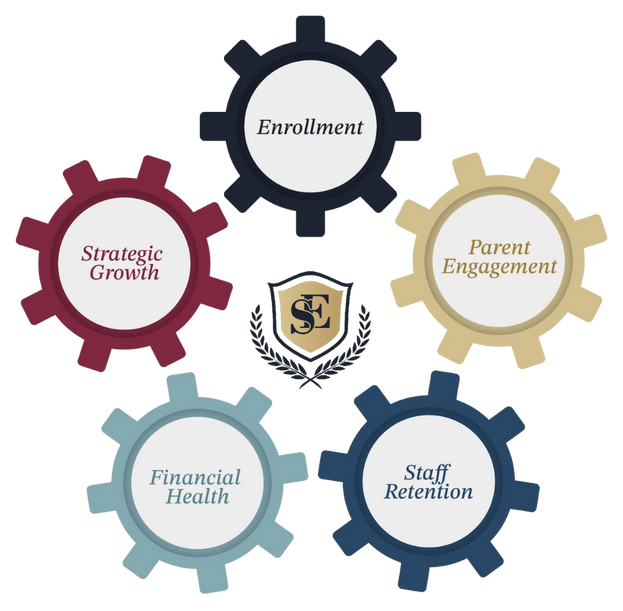
Discover your school's hidden breaking points
Stop Guessing & Start Knowing
with The 5 Gears Diagnostic
Ready to Go Deeper?
If you heard something in today’s episode that you know is a pattern inside your school but you’re not sure how to translate it into infrastructure, that’s exactly the work we do inside Schools of Excellence.
In our leadership consults, we help you identify your patterns, understand what they’re signaling, and know exactly where to prioritize your time, energy, and resources to build real infrastructure — the kind that holds even when you’re not there.
Resources:
- This Can’t Be Normal (Chanie’s book): https://thiscantbenormal.com
- Leadership HQ Membership: https://schoolsofexcellence.com/apply
About Chanie Wilschanski & Schools of Excellence
Chanie Wilschanski is the founder of Schools of Excellence and a sought-after mentor for early childhood and private school leaders. Her work is grounded in building operational systems, emotionally intelligent leadership, and sustainable rhythms for long-term success. Through her podcast, trainings, and membership program, Chanie helps private school and ECE leaders lead with confidence, build high-functioning teams, and step into their full leadership potential—without burnout or chaos.
If this episode resonated with you, share it with another school leader ready to move beyond survival mode and into intentional, systems-driven leadership.