

Listen on Apple Podcast | Listen on Spotify
You care deeply. That’s not in question. You’re warm, empathetic, available — and your heart is genuinely in this work. You’ve softened hard conversations to protect your teachers. You’ve explained things again. And again. You’ve given grace for circumstances, extended second chances, and absorbed the emotional weight of an entire building.
And somehow, nothing has changed.
If you’ve been in that cycle, this is the conversation you didn’t know you needed. Because what looks like strong, supportive leadership on the surface can quietly be the very thing keeping your school stuck — and burning you out in the process.
When Warmth Becomes Over-Functioning
There’s a belief that runs deep in early childhood leadership: if you’re loving and supportive enough, people will naturally grow. It makes sense. You’re working with educators who nurture children for a living. Warmth is the language of your world.
But here’s the distinction that changes everything: warmth without standards doesn’t create growth. It creates emotional management.
“Empathy has become permission. Kindness has replaced clarity. Support has turned into self-soothing. And softness gets mistaken for safety.”
When warmth isn’t paired with standards and consequence, it quietly transforms into over-functioning. You’re not leading people forward — you’re containing them. Rescuing them from the very friction that would have helped them rise.
What does that look like in practice?
- You rehearse the difficult conversation a hundred times, soften it so much the standard disappears, and walk away exhausted — even though nothing was actually resolved.
- The same behavior keeps surfacing, but you add another training session instead of holding the standard you already set.
- You can explain every reason why someone shouldn’t be held accountable this time — her husband traveled, the flu hit the classroom, it’s been a hard season — and so nothing ever changes.
- You smooth over rising tension to make sure no one feels uncomfortable, and then wonder why you feel so alone in all of it.
The pattern isn’t weakness. It’s actually a shield. Warmth becomes a way to avoid conflict, the discomfort of being disliked, the risk of being misunderstood, and the hard work of holding consequences. The team stays comfortable. And unchanged.
The Truth About How Adults Actually Grow
Here’s something most leadership development spaces won’t say out loud: children grow through co-regulation. Adults grow through boundaries and consequences.
Adults do not grow when obstacles are removed. They grow when they encounter a standard. When they feel resistance. When they have to sit in real discomfort and discover a capacity they didn’t know they had. That friction is not the problem — it’s the mechanism.
When leaders keep looping on “I’ll say it better next time” or “I’ll be more patient,” they’re unintentionally sending a clear message to their team: you don’t have to change. I’ll change for both of us.
That’s not empathy. That’s how teams under-function. That’s how culture looks calm on the surface and quietly stagnates underneath — until the day it erupts.
The Real Cost of Avoiding Consequences
When there are no predictable consequences, your team doesn’t experience safety — they experience uncertainty. Does this standard matter today or not? Will it slide if she’s tired? Do I actually need to push myself, or will she handle it? That ambiguity is exhausting for everyone, and it quietly erodes trust in the entire system.
Consequence Is Not Punishment — It’s Predictable Safety
This is the reframe that changes the way you lead.
A consequence isn’t a punishment. It isn’t reactive or emotional. A consequence is a pre-decided response when a standard isn’t upheld. It’s calm. It’s clear. It was established in advance. And that clarity is exactly what creates the safety your team is actually craving.
When consequences become a consistent rhythm inside your school, something shifts:
- People stop second-guessing, because they know what’s coming.
- Emotional labor drops — the system holds the standards, not your nervous system.
- Trust begins to increase, because the culture is finally predictable.
- Adults rise — not out of fear, but because the environment is finally steady enough to grow.
Warmth says: I want to take care of you.
Consequence says: I want to take care of you within the standard.
When the two work together, something genuinely powerful happens in a school.
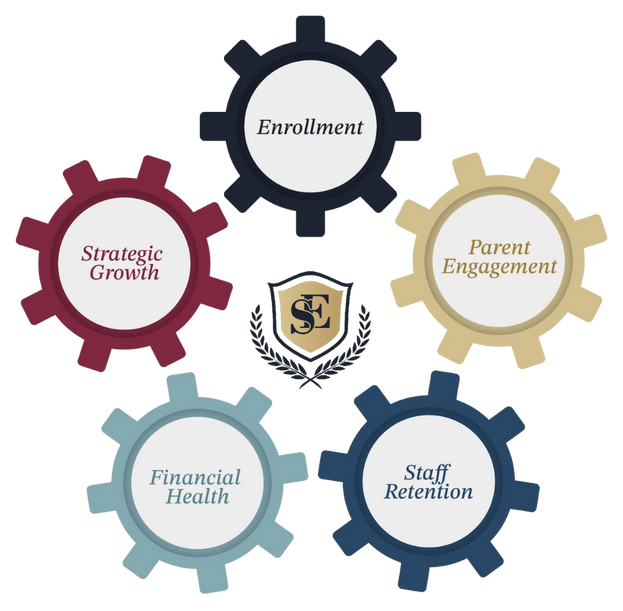
Discover your school's hidden breaking points
Stop Guessing & Start Knowing
with The 5 Gears Diagnostic
What This Looks Like in Your School
This isn’t about becoming colder. It’s not about leading with fear or turning your school into a rigid, compliance-driven environment. In fact, the goal is the opposite.
The invitation is to lead with warmth and standards — empathy and consequence — care without collapsing. You can be deeply human and hold people to what they agreed to. You don’t need to become less kind. You need to stop being the container that every person in your building uses to emotionally offload their responsibility.
A few practical starting points:
Clarify your standards first. Do your teachers actually know what’s expected of them — not just the handbook version, but the real standards? What does excellence look like in enrollment, in parent communication, in showing up on time? If you can’t name it clearly, neither can they.
Pre-decide your consequences. Before you’re in the emotional moment, decide what happens when a standard slips. This removes the reactivity. It also removes the ambiguity that your team quietly lives inside every day.
Recognize that nuance is required. A consequence for someone who has been on your team for 20 years is going to look different than it does for someone in their first 90 days. Context matters. Relationship matters. But the existence of a consequence cannot be optional — that’s where the culture breaks down.
Let the system hold the standard, not your mood. That’s the whole point. When consequence is a rhythm rather than a reaction, the culture runs without relying on how energized, emotionally available, or patient you happen to be on any given day.
Start Here: One Honest Question
If this conversation sparked something — resistance, recognition, or a quiet “this is me” — here’s the invitation. Don’t rush to create a 20-step plan. Don’t turn this into an action item that lives on a to-do list. Just sit with this question:
Why does consequence feel harsh to me? What am I afraid might happen if I install one — and what am I afraid the impact on me might be?
Sometimes an insight is just that. It’s a moment. A new perspective. Consequence isn’t punishment. It’s predictable safety. That alone is worth sitting with.
Because building a school of excellence isn’t about removing discomfort. It’s about creating an environment steady enough that every person inside it — including you — can actually grow.
Want to Go Deeper?
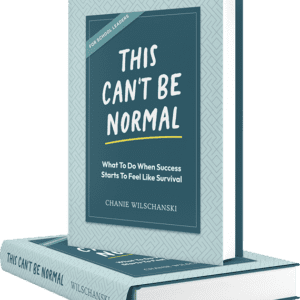
Chanie covers this topic in depth in her book, This Can’t Be Normal, including a full chapter titled “Consequence is Not Punishment — It’s Predictable Safety” and a practical framework for building a rhythm of consequence inside your school. Get your copy at thiscantbenormal.com.
If you’re ready to work through this inside a coaching environment — with nuance, real conversation, and support tailored to where your school actually is — reach out for a private consult or learn more about School Leadership HQ.
About Chanie Wilschanski & Schools of Excellence
Chanie Wilschanski is the founder of Schools of Excellence and a sought-after mentor for early childhood and private school leaders. Her work is grounded in building operational systems, emotionally intelligent leadership, and sustainable rhythms for long-term success. Through her podcast, trainings, and membership program, Chanie helps private school and ECE leaders lead with confidence, build high-functioning teams, and step into their full leadership potential—without burnout or chaos.
If this episode resonated with you, share it with another school leader ready to move beyond survival mode and into intentional, systems-driven leadership.