

Listen on Apple Podcast | Listen on Spotify
You’re Drowning In Your Own Success. And no one’s talking about it.
There’s a version of school leadership that looks great from the outside. Teachers are trained. Systems are in place. Families are engaged. And yet, the leader carrying all of it is quietly suffocating.
Wilschanski calls it “the invisible weight of leadership” — all the anticipating, tracking, and emotionally managing that happens behind the scenes that no one ever sees. Watching a teacher who seems burned out and quietly adjusting. Sensing friction in your team and heading it off before it becomes a real problem. Running mental simulations of what could go wrong before the day even begins.
“It’s all the things that nobody sees, but all need to happen to keep that level of success moving,” she explained.
The cruel irony is that the more effective you are as a leader, the more invisible work you’re doing — and the heavier the load becomes.
Why “Staying Ahead” Is a Trap
Most school leaders cope with the weight by trying to do more. Stay later. Respond faster. Anticipate further in advance. But Wilschanski is direct about why that strategy never works:
You can’t actually get ahead. There is always something else coming — new legislation, community pressure, staff challenges, a shift in enrollment. The horizon keeps moving.
“If we consistently try to stay ahead, we’re never going to be able to,” she said. “There’s always something else coming on the horizon.”
The answer, she argues, isn’t more effort. It’s better rhythms.
What Rhythm-Based Leadership Actually Means
Wilschanski defines a rhythm as “a repeated, intentional pattern of behavior that creates stability inside of yourself or the culture.”
Think of it less like a strict rule and more like an anchor. When you return to a rhythm — a consistent meeting, a protected time of day, a weekly personal ritual — it grounds you. It pulls you back to what actually matters before the current of demands can carry you somewhere else.
She offered a compelling personal example: every Tuesday morning, she and her husband leave the house for breakfast. Same time. No negotiation. No rescheduling.
“It anchors our relationship and what’s important to us,” she said. “We don’t have to negotiate it every week.”
The power isn’t the breakfast itself — it’s the predictability. Because the rhythm is consistent, she doesn’t have to track it. She doesn’t have to protect it with willpower. It simply holds.
That same principle, applied inside a school, creates something that can hold your teachers, your culture, and your community — without requiring you to hold it manually every day.
A Rhythm Every School Leader Needs: The Rhythm of Closure
One of the most practical rhythms Wilschanski shared is what she calls the “rhythm of closure.”
The illusion that haunts school leaders is the belief that if you stay long enough, you’ll catch up. The reality: you will never catch up. There will always be more to do. And the leaders who stay until the work is finished aren’t going to reach that finish line — they’re going to reach burnout.
The rhythm of closure is a pre-decided end time for the work day. Not because everything is done. Because the day is.
“You need a rhythm of closure where you pre-decide: the day ends at five,” she said. “Not because my work is finished, but because the day is. Tomorrow there is more work.”
This removes the nightly negotiation — the “just 10 more minutes” mental bargaining that quietly erodes leaders. Instead, closure is built in. The decision has already been made. And that, paradoxically, is freeing.
Generosity as a Leadership Rhythm
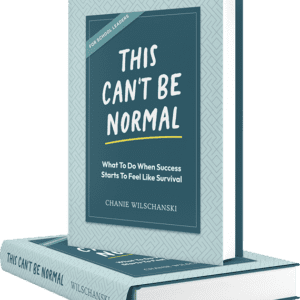
Perhaps the most surprising chapter in This Can’t Be Normal is the one on generosity. It’s a concept that might seem out of place in a book about leadership systems and burnout — but Wilschanski makes a compelling case for why it belongs at the center.
She introduces the Yiddish concept of fargin — defined not simply as being happy for someone else, but as what she calls “a soul-deep exhale that says your win adds goodness to the world, and I’m grateful to witness it.”
In the context of school leadership, generosity shows up differently than you might expect. It’s not about bonuses or gift cards or flying your teachers to conferences.
“Do you give them latitude for their mistakes? Do you give them grace when they’re learning?” she asked. “Are you aware that you were also once 19 or 20 and made mistakes? And now it’s your chance to pay it forward?”
Generous leadership creates the kind of culture where people bring their problems to you early, before they become crises. It also, over time, reduces the emotional labor you’re carrying — because people feel safe enough to handle more on their own.
The Deeper Question: What Are You Actually Trading?
Underlying every chapter of This Can’t Be Normal is a question Wilschanski returns to again and again: what are you trading for your success, and do you actually know you’re trading it?
She references Viktor Frankl’s Man’s Search for Meaning and a line she reads every year: “People have enough to live by, but nothing to live for. They have the means, but no meaning.”
That resonates deeply with school leaders who have achieved everything they set out to achieve — full enrollment, a strong team, community recognition — and still feel like something essential is missing.
“When you have success, the bigger question is: what is the life I’m asking for? What will I sacrifice for it? What are the trade-offs? Is this worth it?” she said.
Rhythm-based leadership, at its core, is a framework for making those trade-offs visible — and intentional — before the weight of invisible decisions makes them for you.
This Is for More Than Just School Leaders
While Wilschanski’s work is rooted in school leadership, she was clear in the interview: the framework in This Can’t Be Normal applies to anyone navigating success that has started to feel like survival.
Mothers. Athletes. CEOs. People entering new seasons of life — becoming grandparents, launching businesses, stepping into new roles.
“It’s for anyone in a position of leadership who has achieved success and wants it to stop feeling like they’re in survival,” she said.
And if you’re a school leader who picks up this book and implements even one rhythm, one anchor, one shift in how you end your day — that’s a real win.
Want support building the rhythms that hold your school even when you’re not? Schools of Excellence helps school leaders create systems, cultures, and rhythms that sustain excellence — without requiring heroics or hustle. Learn more: https://schoolsofexcellence.com/apply
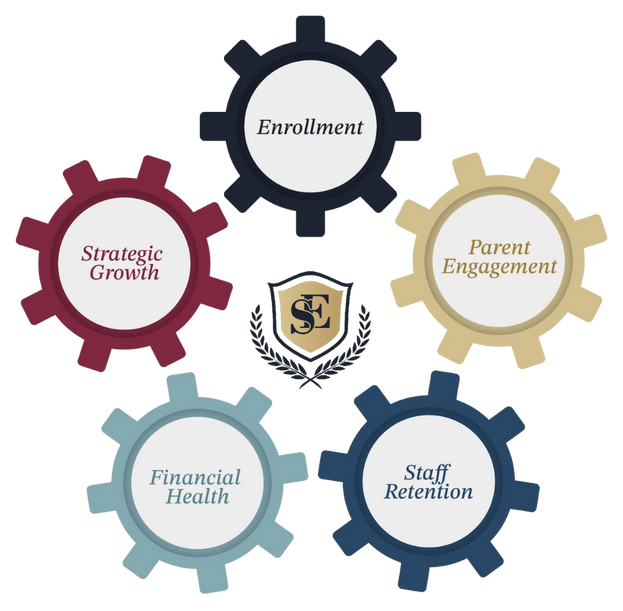
Discover your school's hidden breaking points
Stop Guessing & Start Knowing
with The 5 Gears Diagnostic
Ready to Build Infrastructure That Holds?
Installing standards, ownership, and rhythms that create predictable safety, profitability, and growth — is exactly what happens inside the Schools of Excellence Leadership HQ program.
HQ is for school leaders who are done surviving their own organizations and ready to build infrastructure that holds, even when they’re tired, even when they’re not in the room.
Apply for Leadership HQ → https://schoolsofexcellence.com/apply
And if you haven’t picked up This Can’t Be Normal yet, the book is available worldwide at thiscanbenormal.com.
About Chanie Wilschanski & Schools of Excellence
Chanie Wilschanski is the founder of Schools of Excellence and a sought-after mentor for early childhood and private school leaders. Her work is grounded in building operational systems, emotionally intelligent leadership, and sustainable rhythms for long-term success. Through her podcast, trainings, and membership program, Chanie helps private school and ECE leaders lead with confidence, build high-functioning teams, and step into their full leadership potential—without burnout or chaos.
If this episode resonated with you, share it with another school leader ready to move beyond survival mode and into intentional, systems-driven leadership.