


Listen on Apple Podcast | Listen on Spotify
Every summer, the same thing happens.
Seats aren’t filling as fast as they did in March. Inquiries are coming in, but commitments aren’t. The competition feels heavier than expected. And somewhere in the middle of it all, you tell yourself the same thing: we need to push harder. Post more. Do more promos. Create more urgency.
Here’s what we want you to hear before you add one more thing to your plate: the problem isn’t your effort. And it’s probably not your visibility either.
What summer actually does — what it has a way of doing every single year — is expose your infrastructure gap. It reveals whether you have a real enrollment system, or whether you’ve been running on heroics and momentum.
There’s a difference. And once you see it, you can’t unsee it.
Why Summer Enrollment Feels Harder Now
The competitive landscape has genuinely shifted. You’re not just up against other schools anymore. You’re competing with church camps, VBS programs, specialty camps, and every other family care option that’s vying for the same families at the same time — all with different price points, different scheduling options, and different expectations.
That’s a compressed, high-pressure enrollment window. And if your enrollment ecosystem only functions when conditions are easy and predictable, summer is going to expose every crack in the foundation.
There’s another piece of this that doesn’t get talked about enough: families today wait much longer before making a decision. The days of “we usually fill up by March” are not the reliable baseline they once were. Parents are doing more research, making more comparisons (especially in a world where AI makes that easier than ever), and delaying commitment because life is genuinely uncertain.
When the environment changes but your system doesn’t, you end up saying things like “something feels really off this year.” The environment did change. But the gap that’s showing up? That was already there.
The Real Problem Isn’t Visibility — It’s What Happens After the Inquiry
This is where most leaders misdiagnose the issue and end up solving the wrong problem.
When enrollment slows, the instinct is to do more: more posts, more emails, extended offers, discounts. And while visibility matters — there are specific situations where it absolutely is the issue — most of the time, the breakdown isn’t happening at the top of the funnel. It’s happening in the middle.
The problem is that you don’t have a system that converts delayed decisions.
Read that again, because it matters: you don’t have a system that converts delayed decisions.
Every parent who says “not yet.” Every lead that goes quiet. Every inquiry that responds with “can you send me more information?” and then disappears into the void — those aren’t dead leads. They’re delayed decisions. And when you don’t have a rhythm in place to follow up, nurture, and invite them forward, you lose them. Not because they chose someone else in the beginning, but because someone else followed up at the right time and you didn’t.
What an Enrollment Infrastructure Gap Actually Looks Like
Let’s be specific here, because this shows up in ways that feel normal until you realize it doesn’t have to be this way.
No structured lead tracking. You think you have a system. But in practice, nobody is actually following it consistently. Some leads get a follow-up within an hour. Some get one a day later. Some fall off the list entirely because something came up — and there’s always something that comes up.
Inconsistent follow-up. Research consistently shows it takes between 8 and 12 touchpoints before most people make a decision. If you followed up twice or three times and called it done, you likely lost that lead at touchpoint six — right when they were getting close.
No distinction between “no” and “not yet.” These are not the same thing. A family that says “we’re not sure yet” is in a completely different category than one that says “we’ve decided to go another direction.” When you treat them the same, you abandon people who were genuinely still open.
Enrollment only works when families are ready. If your system only captures the people who are ready to hand over their credit card today, you don’t have an enrollment strategy. You have good timing. And good timing doesn’t scale.
What Strong Enrollment Infrastructure Actually Does
When the foundation is solid, a few key things shift.
Every inquiry becomes a tracked lead — not just someone who’s ready to enroll today. You’re building a pipeline, not just capturing the low-hanging fruit. That lead gets nurtured and invited forward until they’re actually ready to make a decision.
Follow-up happens on rhythm, not randomly. Not once. Not when someone remembers to check the spreadsheet. There is a consistent, predictable rhythm of contact until a decision is made — in either direction. This isn’t about being pushy. It’s about being present and trustworthy at every stage of their decision-making process.
Summer builds forward, not just fills now. Your summer program isn’t just about seats for this season. It’s a feeder for full enrollment. It’s a relationship you’re building for next summer. When summer ends and you haven’t expanded your pipeline, you start over every year. That’s not just exhausting — it’s structurally avoidable.
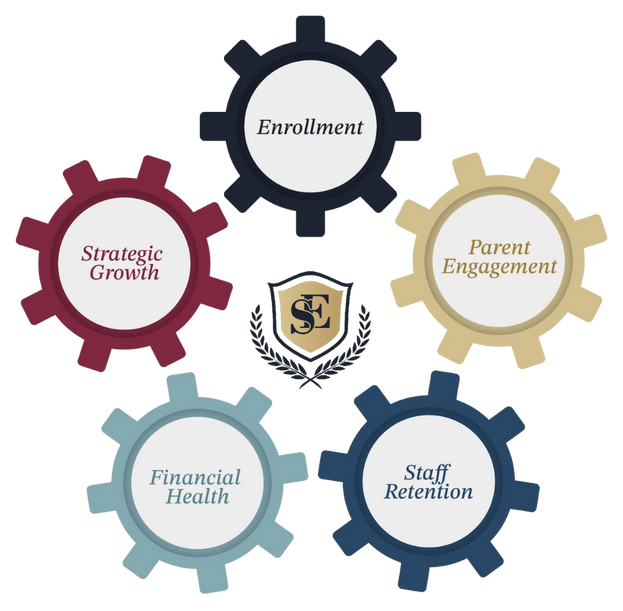
Discover your school's hidden breaking points
Stop Guessing & Start Knowing
with The 5 Gears Diagnostic
What Happens When You Don’t Have the Infrastructure
You already know this part. You’ve lived it.
You discount to compensate for the gap. You feel constant pressure as enrollment numbers become unpredictable. You find yourself white-knuckling through every enrollment season instead of leading through it. And the most frustrating part? No matter how hard you work, nothing compounds. You’re never building toward a more reliable future — you’re just surviving the present one.
The answer is not more effort. It’s not a better checklist or an updated spreadsheet or a new Asana board. Those are cosmetic fixes on a structural problem.
The answer is infrastructure.its
You’re Not Missing Effort. You’re Missing Infrastructure.
If you’re reading this and recognizing yourself — leads slipping through the cracks, follow-up that feels reactive instead of rhythmic, an enrollment season that feels more like bracing for impact than building toward something — this is what we want you to hear:
You don’t need to do more. You need to build something that works when you’re not hovering over it.
That’s exactly what we focus on inside Enrollment Engine. Not just learning the concepts, but actually installing the infrastructure — the lead tracking, the follow-up rhythms, the pipeline-building practices that turn your enrollment from a season you survive into a system you trust.
Because when your enrollment infrastructure is solid, you stop chasing enrollment. Your enrollment starts to compound itself.
That’s the difference between good timing and a real system. And it’s entirely possible to build it — even now, even in the messy middle of a summer season that isn’t going the way you planned.
You can learn more and invest in this asset for your school at https://discovered.thrivecart.com/the-enrollment-engine-curriculum-only/
About Chanie Wilschanski & Schools of Excellence
Chanie Wilschanski is the founder of Schools of Excellence and a sought-after mentor for early childhood and private school leaders. Her work is grounded in building operational systems, emotionally intelligent leadership, and sustainable rhythms for long-term success. Through her podcast, trainings, and membership program, Chanie helps private school and ECE leaders lead with confidence, build high-functioning teams, and step into their full leadership potential—without burnout or chaos.
If this episode resonated with you, share it with another school leader ready to move beyond survival mode and into intentional, systems-driven leadership.