
Listen on Apple Podcast | Listen on Spotify
There’s a version of success that looks really good from the outside.
Strong enrollment. Community roots. A team that feels like family. A school that, on paper, is everything you set out to build.
And then you grow. And everything that used to work… stops working.
That’s the story Charlie Marcotty brought to the Schools of Excellence podcast. With nearly 29 years in early childhood education and four locations just outside of Boston, Charlie had built something genuinely impressive. But this past year pushed her to the edge of everything she’d worked for — and what she did next is exactly why her story matters for every school leader listening right now.
When Growth Breaks the Leader Before It Breaks the System
Here’s what nobody talks about when they tell you to scale: the systems that hold beautifully for one location start to fracture when you add a second, third, or fourth. Not because you’ve done something wrong. But because leadership capacity has to grow at the same rate as your organizational footprint — and most leaders don’t realize that until things have already started to fall apart.
In a single year, Charlie experienced:
- Four directors at a single location in three months
- 50% staff turnover
- High-level leadership walkouts
- Financial disasters
- And nights where she lay awake wondering if she even wanted to keep going
This wasn’t a failure of passion or dedication. This was a leadership infrastructure that hadn’t caught up with the size of the organization she was running.
What she was experiencing had a name: survival mode. And survival mode doesn’t just exhaust you — it costs you in ways that never show up on a spreadsheet. Emotionally. Mentally. Relationally. Spiritually.
The Sneaky Thing About Survival Mode
Survival mode doesn’t announce itself. It creeps in slowly, quietly, one small compromise at a time.
You stop having real meetings. You start communicating by text. You tell yourself you’ll get to the strategic work next week. Next week becomes next month. Next month becomes next year. And suddenly you look up and everything is being held together by duct tape and your own sheer force of will.
The danger isn’t just the exhaustion. It’s that survival mode normalizes dysfunction. When you’re in it long enough, the constant fires stop feeling like a crisis. They start feeling like just… how things are.
And that’s exactly where Charlie found herself.
What Actually Changed Everything (It Wasn’t a New Hire)
When Charlie started working with Schools of Excellence, the first thing Chanie looked at wasn’t enrollment numbers or financials. It was communication. Specifically: when does your team actually talk to each other?
Not by text. Not by email. Not through drive-by conversations in the hallway. When is there real, dedicated, protected connection and conversation?
This distinction matters more than most leaders realize. There’s a significant difference between communicating logistics all day long and actually connecting with your team. Think about it in the context of any relationship: you and a partner could talk all day about who’s picking up the kids, what time dinner is, and whose turn it is to take out the trash — and be completely disconnected. Leadership works the same way. Talking about operations constantly is not the same as building relational trust.
And here’s what Charlie discovered when she looked honestly at that question: they weren’t connecting. The silence between real conversations had been doing damage that nobody could see.
Rhythm as Infrastructure: What Charlie Actually Built
The shift didn’t come from a dramatic overhaul. It came from something much smaller and far more powerful — the installation of protected rhythms.
Charlie built:
- A weekly executive team meeting — a protected space where senior leaders could surface priorities, support each other, and communicate honestly without the pressure of being “on”
- A monthly enrollment meeting focused on metrics, wins, and forward goals
- A monthly cross-functional gathering bringing together nine specialists across the entire org chart, each with a unique role, to share voice and collaborate
Each of these containers replaced conversations that had been happening in WhatsApp threads, parking lot chats, and hallway moments — or not happening at all.
But here’s the critical part: it wasn’t enough to schedule these meetings. The transformation came from making them non-negotiable. Not when everyone was available. Not when there wasn’t a fire to put out. Every single week, no matter what. If someone was pumping gas, they logged into Zoom. If someone was working remotely, they showed up.
Consistently. Predictably. Reliably.
That is rhythm-based leadership.
Why Rhythm Works When Policy Doesn’t
Something remarkable happened when Charlie’s team began showing up to these containers week after week. Accountability started to build — not from a new policy or a performance improvement plan, but from rhythm itself.
When you, as the leader of your organization, dedicate your most precious asset — your time — to a recurring, protected conversation, you send a signal to the entire organization: this is a priority. And when something is a priority, people move. People change how they show up. People change the patterns of their behavior.
This is the difference between having structures in place and creating sustainable rhythms. Structures are inert. Rhythms are living. Rhythms communicate values. Rhythms create safety.
Systems create structure. Rhythms create safety. And Charlie’s team started to feel it.
The Leader Has to Shift First
Here’s what won’t be comfortable to hear, but is completely true: none of these rhythms would have taken hold if Charlie hadn’t made the internal shift first.
You can install every meeting structure in the world. You can implement all the SOPs, the checklists, the software, the onboarding processes. If the leader running those systems isn’t fully present, honest about where she is, and genuinely committed — it’s all just expensive scaffolding.
Charlie had her reckoning moment. And she described it with a phrase that landed like a quiet thunderclap:
“If we’re gonna be here, let’s be here.”
So many school leaders operate in a kind of in-between space — not fully in, not fully out. Enduring. Tolerating. Overfunctioning. Waiting for conditions to be better before they decide to truly lead.
But here’s the truth Charlie’s story reveals: the conditions for change don’t appear first, and then you decide to lead. You decide to lead. You make the standards. You clear the ownership. You build the rhythms. And that’s when the conditions for change actually appear.
When You Raise the Bar, Something Has to Give
When Charlie made that decision, something remarkable happened: the dysfunction that had been sitting in plain sight finally became visible.
A high-level team member left. And what followed was the realization of just how much toxicity had been quietly normalized because of that person’s presence. Rather than treating it as a catastrophe, Charlie treated it as an opening — a chance to enter a new era of leadership.
This is what friction actually looks like in practice. Change doesn’t happen without discomfort. In fact, if you introduce new standards and nothing feels uncomfortable, you don’t yet have standards. You’re still in appeasement mode.
When you raise the bar, one of two things happens: people rise to meet it, or they reveal that the dysfunction was actually working for them. And those who self-select out? That’s not failure. That’s the infrastructure working exactly as it should.
What Charlie’s Story Means for You Right Now
Charlie’s team is more resilient today. Their conversations are more functional. They’ve adopted a new organizational mantra rooted in prevention rather than reaction. And she’s continuing to build — not because things are perfect, but because she keeps returning to her rhythms, her standards, and her commitment to lead from a place of intention.
Because here’s the final thing to understand: you don’t move once from firefighting to prevention. You don’t make a single decision and coast from there. The arc of transformation requires returning — again and again — to the rhythms, the meetings, the check-ins, the standards.
The power of rhythm isn’t in the one big initiative. It’s in the return. It’s in showing up again and again and saying: this matters, and I’m not going to stop showing up for it.
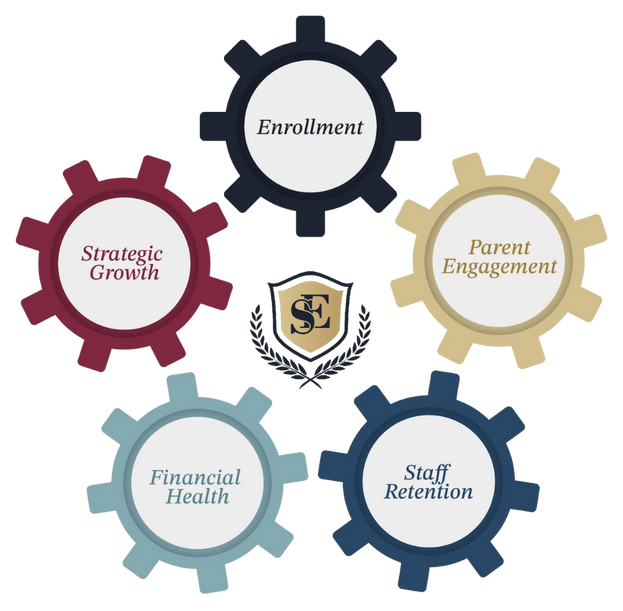
Discover your school’s hidden breaking points
Stop Guessing & Start Knowing
with The 5 Gears Diagnostic
Three Questions to Sit With
Before you move on with your day, Chanie invites you to honestly reflect:
Where are you still holding the invisible weight of leadership by yourself?
Where are you relying on personality and heroics instead of returning to rhythm?
Where does your school look stable on the outside but feel fragile underneath?
If those questions land somewhere tender, that’s not a sign that something is wrong with you. It’s a sign that you’re ready for what comes next.
Ready to Build Infrastructure That Holds?
The work Charlie did — installing standards, ownership, and rhythms that create predictable safety, profitability, and growth — is exactly what happens inside the Schools of Excellence Leadership HQ program.
HQ is for school leaders who are done surviving their own organizations and ready to build infrastructure that holds, even when they’re tired, even when they’re not in the room.
Apply for Leadership HQ → https://schoolsofexcellence.com/apply
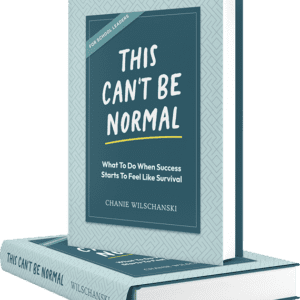
And if you haven’t picked up This Can’t Be Normal yet, the book is available worldwide at thiscanbenormal.com.
About Chanie Wilschanski & Schools of Excellence
Chanie Wilschanski is the founder of Schools of Excellence and a sought-after mentor for early childhood and private school leaders. Her work is grounded in building operational systems, emotionally intelligent leadership, and sustainable rhythms for long-term success. Through her podcast, trainings, and membership program, Chanie helps private school and ECE leaders lead with confidence, build high-functioning teams, and step into their full leadership potential—without burnout or chaos.
If this episode resonated with you, share it with another school leader ready to move beyond survival mode and into intentional, systems-driven leadership.