


Listen on Apple Podcast | Listen on Spotify
You’re mostly full. Teachers are in their classrooms. Families seem happy. And yet, something keeps nagging at you — a quiet feeling that your school could be doing more.
Here’s the uncomfortable truth: being 80–85% enrolled isn’t the same as being financially healthy. And the gap between “good enough” and “excellent” is costing thousands of school leaders tens of thousands of dollars every single year — not in obvious ways, but in slow, invisible leaks they’ve learned to normalize.
In this episode of the Schools of Excellence podcast, we’re pulling back the curtain on four profit blind spots that drain school revenue without triggering a single alarm. These aren’t hypothetical scenarios — they’re patterns we see inside real schools, every week.
Let’s walk through each one.
Blind Spot #1: The False Comfort Zone
There’s a particular kind of financial danger that hides behind the words “we’re doing really well.”
If your school is running at 80–85% capacity, it might feel like a win. And it can be — until you do the math.
|
Two empty spots in a pre-K classroom at $1,200/month = $2,500 in lost monthly revenue. That’s $30,000 a year — left on the table while you feel comfortable. |
But the false comfort zone doesn’t just cost you the obvious empty-spot money. It also masks what’s happening underneath:
- Families quietly withdrawing because retention rhythms aren’t solid
- Prospective families slipping away while your focus is on those two open spots
- Patterns going unaddressed because everything feels “fine enough”
It’s like that slow tire leak. You can keep driving on it — until you can’t.
We worked with a school leader last month who was sitting comfortably at 80% capacity. She wasn’t panicking. She wasn’t in crisis. But when we helped her implement a more intentional follow-up rhythm, she filled every remaining spot within two weeks and built a waitlist that generated an additional $45,000 in summer program revenue.
The danger isn’t the empty spots. It’s deciding that good enough is good enough.
Blind Spot #2: Invisible Money Leaks
This one has nothing to do with your pricing. You’ve already done that work — agonizing over your rates, making sure they’re competitive, making sure they make sense.
The problem is that even the right price can’t save you if your enrollment process has holes in it.
The Inconsistent Tour Problem
Picture this: your director Sarah gives tours on Mondays and emphasizes your curriculum. Your admin team member Maria gives tours on Wednesdays and highlights your beautiful facility. Both are great. But families are getting entirely different experiences — and you have no way of knowing which message is actually converting them.
Without a consistent tour process, you’re not running an enrollment strategy. You’re running an experiment.
The Follow-Up Black Hole
A family tours your school. They love it. They say “we’ll think about it” — and then life happens. Someone’s child gets sick. A staff meeting runs long. An emergency comes up. Two weeks pass. The family has enrolled somewhere else.
The follow-up black hole isn’t a personal failure. It’s a systems failure. And the fix isn’t willpower — it’s building rhythms that hold families through the decision-making process without relying on you to remember.
Missed Conversion Moments
These are the small, daily interactions that either build value for your school — or quietly erode it:
- A parent asks about your rates and gets a price sheet instead of a compelling response
- A family mentions the commute is far and the conversation ends instead of pivoting to your school’s differentiators
- A concerned parent raises an objection and no one on your team has a practiced, confident answer
We worked with a multi-location school owner whose enrollment was consistently leaking. We addressed just two of these areas — her tour messaging and her systematic follow-up process — and within one week, she enrolled three new families. Same questions. Same concerns. The only difference was a real system for how to respond.
Blind Spot #3: Your Team Is Your Most Underutilized Enrollment Asset
Before anything else: this is not about your teachers’ ability to educate, nurture, or create extraordinary experiences for children. They do that. We know they do.
But here’s the distinction that changes everything: being exceptional with children and being able to articulate that value to parents are two completely different skill sets.
|
We were coaching a school when a parent asked Jenny — the school’s best pre-K teacher, mid-lesson — “What are the kids learning here?” Jenny looked up and said, “Oh, they’re just playing right now.” But they weren’t just playing. They were developing fine motor skills. Practicing peer negotiation. Working through mathematical concepts through block play. None of that was said. |
That gap — between what’s actually happening in your classroom and what families hear — is costing you enrollments.
And it’s not just during formal tours. It’s every drop-off conversation. Every pickup exchange. Every time a parent raises an eyebrow at tuition and your front office team doesn’t know how to respond with clarity and conviction.
The good news: this is one of the easiest blind spots to close. You don’t need new teachers. You don’t need to turn your educators into salespeople. You just need to give them better words — the language to translate the incredible work they’re already doing into something parents can see, feel, and say yes to.
When we worked with a school in Florida and implemented what we call the Value Vision training, their tour conversion went up — with the same teachers, same classrooms, and same exceptional curriculum. The only thing that changed was how the story was being told.
Blind Spot #4: Reactive Scheduling (The “I’ll Get to It” Trap)
You know the mental list. The follow-up you were going to send to the family who toured last week. The enrollment training you’ve been meaning to do with your teachers for the past month. The inquiry from the mom you met at the grocery store who asked about your infant program.
Then life hits. A teacher calls out. A parent demands an urgent meeting. A licensing inspector arrives unannounced. And the revenue-generating activities get pushed to “later.”
|
We spoke with a school owner who had seven families tour her school in a single week. Great tours. Excited parents. Perfect fit for her program. Zero enrollments. Why? She hadn’t followed up with any of them. Seven families at $1,200/month = $8,400 in monthly revenue. That’s over $100,000 lost annually — because follow-up wasn’t scheduled. |
Your calendar is not a to-do list manager. It is your most powerful enrollment tool.
When we helped a director implement what we call a Profit Calendar — intentional, non-negotiable blocks for enrollment-generating activity — her conversion rate went up by over 20% in a single month. Same number of inquiries. Same program. Same team.
Here’s what the rhythm looked like:
- 30 minutes every morning for fresh inquiry follow-up
- One hour every Tuesday and Thursday for touring family check-ins
- Two hours every month for team training on enrollment
When you stop letting your day run you — and start running your day with profit-generating intention — everything changes.
The Through Line: You Don’t Lose Money in Obvious Ways
Missed follow-ups. Inconsistent tours. I’ll get to it later. These are the patterns that become so normalized we stop seeing them as problems.
There’s one more that deserves a mention: call-outs.
Call-outs have become so common in childcare operations that most leaders have simply absorbed them into their daily chaos. But they’re not neutral. We worked with a school doing over $2 million in annual revenue that was losing $250,000 per year to call-out costs — and she didn’t see it until we showed her the math.
The same principle applies across every blind spot we covered today: you cannot fix what you cannot see. And once you can see it, the fix is almost always simpler than you expect.
What This Means for Your School
Every single blind spot we covered today — the comfort zone, the leaks, the team gap, the reactive calendar — is fixable. Not in some ideal scenario with unlimited time and resources. Right now, in your school, with the team you have, in the middle of the daily chaos.
This is what we teach at Schools of Excellence: how to identify what’s quietly draining your revenue and build the rhythms and systems that hold your enrollment process together — without relying on heroics, hustle, or you being available every moment of every day.
You’re not losing money because you’re a bad leader. You’re losing money in patterns you’ve learned to call normal. And that’s the most fixable problem there is.
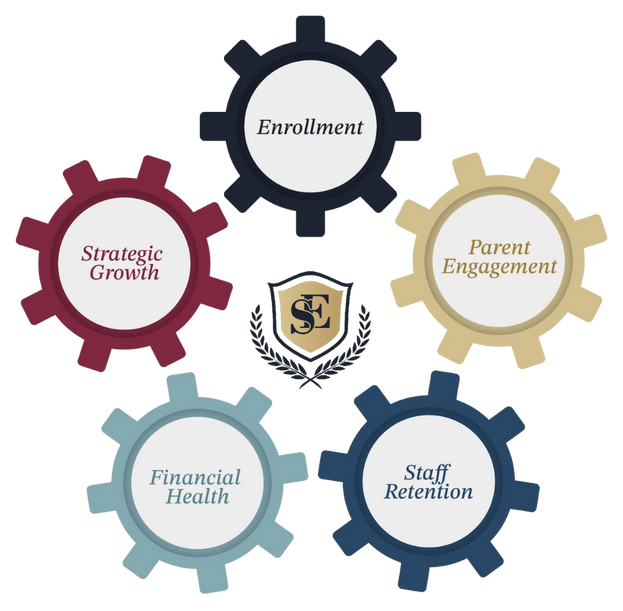
Discover your school’s hidden breaking points
Stop Guessing & Start Knowing
with The 5 Gears Diagnostic
Ready to Build Infrastructure That Holds?
Installing standards, ownership, and rhythms that create predictable safety, profitability, and growth — is exactly what happens inside the Schools of Excellence Leadership HQ program.
HQ is for school leaders who are done surviving their own organizations and ready to build infrastructure that holds, even when they’re tired, even when they’re not in the room.
Apply for Leadership HQ → https://schoolsofexcellence.com/apply
And if you haven’t picked up This Can’t Be Normal yet, the book is available worldwide at thiscanbenormal.com.
About Chanie Wilschanski & Schools of Excellence
Chanie Wilschanski is the founder of Schools of Excellence and a sought-after mentor for early childhood and private school leaders. Her work is grounded in building operational systems, emotionally intelligent leadership, and sustainable rhythms for long-term success. Through her podcast, trainings, and membership program, Chanie helps private school and ECE leaders lead with confidence, build high-functioning teams, and step into their full leadership potential—without burnout or chaos.
If this episode resonated with you, share it with another school leader ready to move beyond survival mode and into intentional, systems-driven leadership.